Remembering 2002 FIFA World Cup
When I was a boy growing up in Chengdu, China, many of my friends played football. I did too, often at the expense of studying for school exams. Then, one day when I was in junior high school, my mother told me that I should stop playing football and start studying harder for exams, because I was not going to make a good living by playing football. My mother was not talking about my athletic potential, which admittedly I did not have any; she was simply stating the fact that in late nineteen seventies and early eighties, there was no professional football in China.
The Chinese professional league did not start until 1994. Before that, players for China’s national team were selected from a hierarchical system. Promising boys were sent to specialized schools in early age. From there players were selected to form youth teams at every level of the government, from counties and cities to provinces, and the best players were then selected from provincial teams to form the national team. This kind of state-sponsored selection system is still being used for sports such as diving, gymnastics, and weightlifting. For sports that do not have a lot of market values — athletes earn little money and there is little commercial sponsorship — this system has an advantage. But for sports like football and tennis, the state-sponsored system does a poor job both in identifying promising young athletes and providing incentives for investments in developing them into world beaters.
The first attempt at qualifying for the world cup by the Chinese national team I remember was for 1978 tournament. Television sets were a novelty back then. In the residential compound where my family lived, there was one television set. I remember sitting on a little wooden stool very close to the TV and watching football games in China’s qualifying campaign. The Chinese national team would fail repeatedly to qualify for world cup since then. Ever four years, the entire nation would dare to hope, become engrossed with the qualifying games of the Chinese national team, and get crushed by the inevitable failure. Between two cycles, there would be plenty of self-pity. The cruelest joke I heard was: Question. What is the problem with a Chinese footballer? Answer. There are two; one is his left foot and the other his right foot. Like a lot of young people, I was never so cynical. I promised myself that if China ever qualified for the world cup, I would go watch all their games.
Then it happened in 2002. It was the first world cup hosted outside of Europe and America. It was also the first ever world cup co-hosted by two countries, South Korea and Japan. Asia was given four and a half spots at the world cup — two for the co-hosts, two for the winners in two qualifying groups and a one-half spot for a playoff against New Zealand. Both South Korea and Japan were already dominant in Asian football, and given the small quota for Asia prior to 2002 — it was just three and a half for 1998 — the two countries were the reasons that China failed to qualify for world cup after world cup. With automatic qualifications as hosts for South Korea and Japan for 2002, China managed to grab one out of the remaining two and a half spots as winner of one qualifying group.
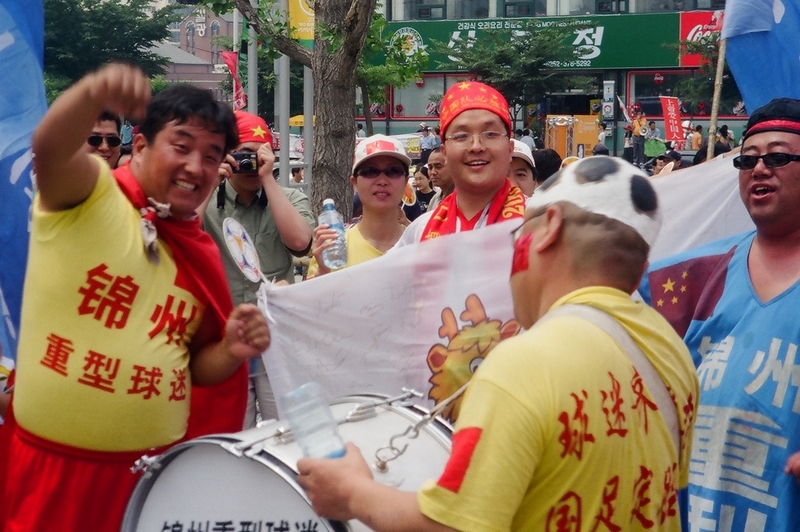
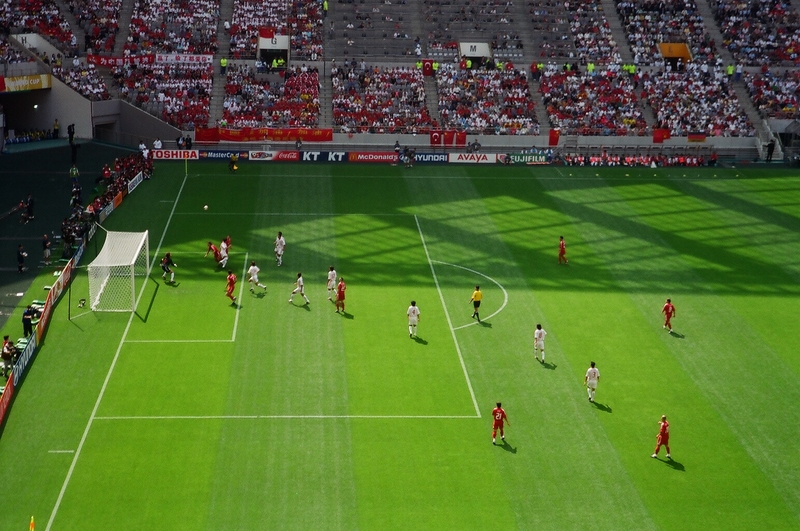
I bought tickets to China’s all three group stage games from Toronto as soon as China qualified. The three games were held in three cities in South Korea: against Costa Rica in Gwangju, against Brazil in Jeju, and against Turkey in Seoul. China lost all three and did not score a single goal: the results were 0-2, 0-4 and 0-3. China had the misfortune of being in the group as Brazil, the eventual winner, and Turkey, a semi finalist and the third place winner. So the results were hardly surprising. The games were really poor from China’s perspective, but I got to see Brazilian legends Ronaldo, Ronaldinho, Rivaldo and Roberto Carlos in action, each scoring a goal against China.
The historical step taken by the Chinese national team in 2002 turned out to be a false dawn. Since then Chinese football only got worse and worse. By the time I visited Korea for the second time, the Chinese national team would lose to not only traditional Asian power houses like South Korea and Japan in East Asia, Iran and Saudi Arabia in West Asia, but also newcomers like Thailand, Malaysia and Oman. What happened was that after the Chinese professional football league started in 1994, it quickly became corrupt. Referees, Coaches, and even players realized that there was a lot of more money to be made from illegal gambling by rigging league games. When scandals broke out, prominent referees and players as well as officials in Chinese Football Association were charged, arrested and put in jail.
In contrast to South Korea and Japan, which established their professional football league not much earlier than China did, the change from the old selection system sponsored by the state to a market system based on performance in the professional league, has not worked out as it should for the Chinese national team. Whether the change has made Chinese football worse is hard to say; maybe it has not made much impact but other countries have improved. What is clear is that simply introducing the market system with professional league was never going to be enough. The market system meant that there were monetary incentives in identifying football talent at a young age and investing in turning them into professional footballers. But the monetary incentives have to be carefully channelled and regulated, for otherwise they can become sources of corruption and other wrongdoing, ultimately leading to inept performance in the world stage.